The postman has just delivered the result of my assessment for Art of Photography. I got 60% overall, which is equivalent to a 2:1. There are individual marks for skills, knowledge, invention, communication, and judgement.
The written feedback made references to my experimentation, inventiveness, and developing technical and communications skills. My work was described as 'visually engaging and showing emerging personal identity'.
What have I learned?
The detailed marks give an indication of areas that I can improve upon. This is something that I will bear in mind as I progress to the next module. It's not just about fulfilling the brief and taking interesting photographs, it's also about developing and demonstrating a specific skillset.
I'm very happy!
Thursday, 16 December 2010

Friday, 26 November 2010
Accreditation of Prior Experiential Learning (APEL)
I received the results of my application today. I applied for exemption from the remaining two level 1 units of my photography degree and was granted exemption from Digital Photographic Practice but not People and Place.
I have enjoyed working my way through Art of Photography. My pictures have definitely improved and I was forced to tackle subjects that I wouldn't normally photograph, but I wanted a more demanding level of study.
I'm a little disappointed that I can't start level 2 immediately, but think People and Place will be interesting, particularly in view of my new role with the casting agency. My enrolment form has been submitted and I look forward to receiving my new study materials.
I have enjoyed working my way through Art of Photography. My pictures have definitely improved and I was forced to tackle subjects that I wouldn't normally photograph, but I wanted a more demanding level of study.
I'm a little disappointed that I can't start level 2 immediately, but think People and Place will be interesting, particularly in view of my new role with the casting agency. My enrolment form has been submitted and I look forward to receiving my new study materials.
Thursday, 25 November 2010
GBSEx III
I spent the weekend in Manchester at the third annual Great British Salsa Experience Congress. This is by far the UK's best salsa weekender and an opportunity to catch up with friends from all over the country as well as overseas.
This was also a very important event for Dos-Seis Dance Company who were able to showcase their current routine to an international audience for the first time. I captured the girls preparing for their congress début in Manchester Town Hall and converted the images to black and white in Lightroom.


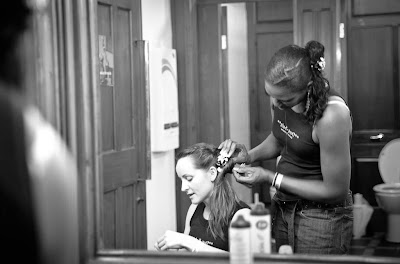

This was also a very important event for Dos-Seis Dance Company who were able to showcase their current routine to an international audience for the first time. I captured the girls preparing for their congress début in Manchester Town Hall and converted the images to black and white in Lightroom.


Thursday, 11 November 2010
Dos-Seis Dance Company
My friend manages a dance group and asked me to take some publicity shots of them last Saturday. Their début performance is this Sunday and the images have been posted on Facebook, included in a promotional video and will be uploaded to their website.
I bought a background support and some black muslin recently. I have played with this set up at home, but this was my first opportunity to use it with live models. We were in a large studio as the group had planned to rehearse after the photoshoot so there was plenty of room and plenty of light. I used a couple of the studio's built-in spotlights as continuous light sources rather than use my speedlights.


I bought a background support and some black muslin recently. I have played with this set up at home, but this was my first opportunity to use it with live models. We were in a large studio as the group had planned to rehearse after the photoshoot so there was plenty of room and plenty of light. I used a couple of the studio's built-in spotlights as continuous light sources rather than use my speedlights.


What have I learned?
These dancers all had poses worked out in advance and in view of the purpose of the photographs, they are highly stylised. However, I still think their individual personalities shine through.
I had to darken the background in Photoshop so, in future I need to try and underexpose the background at the time of capture. In some instances, a bit of back/rim lighting would have been useful to lift the subjects from the background.
Sunday, 7 November 2010
Family Photoshoot
My friend booked me to take some pictures of herself and her children on Monday 25 October. She wanted pictures taken at her home, but I told her beforehand that I would like to also use her garden depending on the weather. As it turned out, the weather was perfect - bright but overcast for most of the time though the sun did make an appearance once or twice.
This is a very small selection of the images:


This is a very small selection of the images:

I wanted to make use of the strong backlight coming through the living room window. I used a silver reflector as the subjects are all young and ISO 400. The image was a little underexposed but this was rectified in Lightroom.

This was lit by combining natural light and ISO 1000. I added a little bit of fill light in post-processing as the girl was in shadow. I like the effect of the lens distortion on the boy's legs. His mother commented that she liked this too.

I bounced the flash off the ceiling to my left (ISO 1000) and applied a cream tone in Lightroom. I think the shadow adds form to the image, but I diffused the light because I didn't want the shadow to have hard edges.

I used the bounced flash technique again (ISO 400) and applied a black and white vignette in post-processing. This is my favourite shot of the day as it conveys the relationship between mother and daughter.
What have I learned?
I'm very pleased with the quality and impact of light in all of the images. For the first time, I felt confident about placing the subjects and making decisions about using my reflector and/or speedlight.
I am also happy that the pictures look natural and not posed. I was fortunate to have subjects happy to have their pictures taken and quite relaxed in front of the camera.
Wednesday, 27 October 2010
Streamlining my Workflow
I am just about to finish an online course called Adobe Lightroom - A Comprehensive Look.
At the moment, I am using Bridge, Adobe Camera RAW (where appropriate) and then Photoshop. I tinkered with Lightroom back in 2008 but didn't really understand it and felt that Photoshop was a better option for me as I wasn't batch processing at that time.
Now that the number of images I am taking has increased and many of them are in RAW, my current workflow is proving to be a little too slow. I'd really like to batch process my images and avoid using Photoshop unless I absolutely have to.
Lightroom 3 has just about all of the features I use on a regular basis and the online course was spread over 4 weeks covering all of the main features in a lot of detail. I'm looking forward to seeing what difference it makes to my post-processing.
At the moment, I am using Bridge, Adobe Camera RAW (where appropriate) and then Photoshop. I tinkered with Lightroom back in 2008 but didn't really understand it and felt that Photoshop was a better option for me as I wasn't batch processing at that time.
Now that the number of images I am taking has increased and many of them are in RAW, my current workflow is proving to be a little too slow. I'd really like to batch process my images and avoid using Photoshop unless I absolutely have to.
Lightroom 3 has just about all of the features I use on a regular basis and the online course was spread over 4 weeks covering all of the main features in a lot of detail. I'm looking forward to seeing what difference it makes to my post-processing.
Wednesday, 20 October 2010
The British Face

I just watched this DVD which I bought from the National Portrait Gallery in August. It follows the actress Fiona Shaw as she examines the concept of portraiture and is divided into 2 sections.
1. Portraits & the Artist
This is about the relationship between the artist and the sitter. It concentrates on the intent of the artist, and there is a general consensus that the artist is trying to capture the 'character' or 'essence' of the subject. It is suggested that this is perhaps why passport photographs are not usually referred to as portraits.
The artist Stuart Pearson Wright talks about the intimacy between artist and subject who often do not exchange words. I thought this was an interesting idea because, on the one hand not speaking to someone you are spending time with can be difficult unless you are very comfortable with each other (assuming that the silence is not because you have fallen out!). But I have found that taking photographs of people without giving them immediate feedback can sometimes unnerve them. I suppose it depends on how comfortable they are about having their picture taken, and their expectations of the end result.
Stuart Pearson Wright discusses the tension between flattery and the truth. He avoids the former because this might imply that the subject is defective in some way. This differs from the approach taken when photographing celebrities where true likenesses are often cast aside in favour of what a film company or product manufacturer might want.
Francis Bacon took an expressionist approach and painted friends and lovers in their absence as he remembered them. These were not always well received, in fact Cecil Beaton destroyed Bacon's painting of him, such was his dissatisfaction.
The photographer Rankin said that photography was about creating 'visual lies' and his objective was to try and get to the truth. In order to do so, he would have a character or narrative in mind while taking the photograph.
2. Portraits & the Nation
This puts portraiture in a wider context and starts with the history of it. It was suggested that originally, portraiture had 3 main purposes: commemoration of the dead, representation of an icon and the celebration of an individual.
The subject of symbolism is introduced by Gerald Scarfe who uses this in his caricatures, and again the notion of 'the truth' and what it constitutes, is mentioned.
I personally think the idea of truth is both subjective and contextual. Everyone has their own interpretation of the truth and this can be affected by external influences.
The final part of the DVD is about the history of the National Portrait Gallery. It was founded to celebrate the achievements of notables who had been deceased for at least 10 years. Therefore, it was focussed on the past, and careful consideration was given as to who was considered worthy enough to have their portraits displayed in the gallery. In the case of scientists and some writers, their portraits served to illuminate their biographies in the case of those who were not immediately recognisable.
Over time, the range of exhibits has widened to include sculpture and photography, and the trustees have allowed the admission of living sitters since the 1960's. During the 1980's the gallery began to commission works of art so they are now creating it as opposed to simply collecting it.
What have I learned?
Portrait photography is a relatively new venture for me and I really like the idea of trying to capture the character of the subject. I read a comment from a wedding photographer once, who said that their aim was to try not to make the subject look like someone having their photograph taken.
I have been asked to do a photoshoot for a friend and her children next week, and in the first week of November I am doing a shoot for a dance group. Two very different types of image but in many ways very similar. Building a rapport with a subject is certainly important and the DVD has given me some ideas on what my psychological approach could be.
1. Portraits & the Artist
This is about the relationship between the artist and the sitter. It concentrates on the intent of the artist, and there is a general consensus that the artist is trying to capture the 'character' or 'essence' of the subject. It is suggested that this is perhaps why passport photographs are not usually referred to as portraits.
The artist Stuart Pearson Wright talks about the intimacy between artist and subject who often do not exchange words. I thought this was an interesting idea because, on the one hand not speaking to someone you are spending time with can be difficult unless you are very comfortable with each other (assuming that the silence is not because you have fallen out!). But I have found that taking photographs of people without giving them immediate feedback can sometimes unnerve them. I suppose it depends on how comfortable they are about having their picture taken, and their expectations of the end result.
Stuart Pearson Wright discusses the tension between flattery and the truth. He avoids the former because this might imply that the subject is defective in some way. This differs from the approach taken when photographing celebrities where true likenesses are often cast aside in favour of what a film company or product manufacturer might want.
Francis Bacon took an expressionist approach and painted friends and lovers in their absence as he remembered them. These were not always well received, in fact Cecil Beaton destroyed Bacon's painting of him, such was his dissatisfaction.
The photographer Rankin said that photography was about creating 'visual lies' and his objective was to try and get to the truth. In order to do so, he would have a character or narrative in mind while taking the photograph.
2. Portraits & the Nation
This puts portraiture in a wider context and starts with the history of it. It was suggested that originally, portraiture had 3 main purposes: commemoration of the dead, representation of an icon and the celebration of an individual.
The subject of symbolism is introduced by Gerald Scarfe who uses this in his caricatures, and again the notion of 'the truth' and what it constitutes, is mentioned.
I personally think the idea of truth is both subjective and contextual. Everyone has their own interpretation of the truth and this can be affected by external influences.
The final part of the DVD is about the history of the National Portrait Gallery. It was founded to celebrate the achievements of notables who had been deceased for at least 10 years. Therefore, it was focussed on the past, and careful consideration was given as to who was considered worthy enough to have their portraits displayed in the gallery. In the case of scientists and some writers, their portraits served to illuminate their biographies in the case of those who were not immediately recognisable.
Over time, the range of exhibits has widened to include sculpture and photography, and the trustees have allowed the admission of living sitters since the 1960's. During the 1980's the gallery began to commission works of art so they are now creating it as opposed to simply collecting it.
What have I learned?
Portrait photography is a relatively new venture for me and I really like the idea of trying to capture the character of the subject. I read a comment from a wedding photographer once, who said that their aim was to try not to make the subject look like someone having their photograph taken.
I have been asked to do a photoshoot for a friend and her children next week, and in the first week of November I am doing a shoot for a dance group. Two very different types of image but in many ways very similar. Building a rapport with a subject is certainly important and the DVD has given me some ideas on what my psychological approach could be.
Subscribe to:
Posts (Atom)