This was the title of an exhibition I went to yesterday evening at the Estorick Collection. It consisted of 50 black and white photographs of Naples taken by Johnnie Shand Kydd between 2000 and 2008. He chose to use a Rolleiflex (square format film camera) because he thought this would convey the ambience of the city better than a digital camera.
His images reveal a darker side to the city and highlight the significance of ritual, religion and superstition to its inhabitants.
The images were divided between 2 galleries, and in each room we were given a narrative. One of the narrators was a young lady who worked for the Magnum agency and was able to put the images into context by commenting on composition, lighting and texture and making references to other photographers and cinematographers (eg Fellini).
The other narrator was a friend of Johnnie Shand Kydd who was able to give us insightful and amusing anecdotes on the stories behind the images and the thought processes of the photographer.
It was interesting to get 2 different perspectives and the ability to ask questions was a unique opportunity. The next best thing to speaking to the photographer himself.
Naples is known as the Siren City because of the legend of Parthenope who tried (unsuccessfully) to seduce Ulysses with the beauty of her song, then threw herself into the sea, only to be washed up at the place that later became known as Naples.
Wednesday, 14 July 2010

Tuesday, 13 July 2010
T-Mobile Big Dance 2010
This is a biennial event and is "the world’s biggest and most influential dance initiative". It took place on Sunday in Trafalgar Square. A friend of mine was taking part so I went along to get some pictures.
I'm only posting a few images at this time because I plan to use them for the narrative picture essay in the final part of the course.


I'm only posting a few images at this time because I plan to use them for the narrative picture essay in the final part of the course.


Monday, 12 July 2010
Mojito Free Sunday Salsa
This is a monthly event that a friend of mine hosts in Chingford. It's very popular and she often has a guest performer. On this ocassion it was Marosh and Kristina.


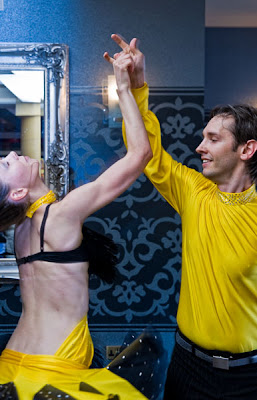


I'm pleased with all except the second and fourth images because you can see the effect of the flash on the wall, but I'm much more confident using the bounced flash technique.
Tuesday, 6 July 2010
Vampire Photoshoot
On Sunday afternoon, I met up with fellow members of a photography group for a vampire themed photoshoot in Guildhall, London. This is a selection of the colour and infrared shots that I took.


Monday, 5 July 2010
Outdoors at Night ...One Last Time

This is the Coliseum on St Martin's Lane, the home of the English National Opera. A very attractive building when it's all lit up and I wanted to capture the name in the revolving sign at the top.

This is Charing Cross Station. The mixed lighting sources played havoc with the auto white balance so I had to do some colour correction in Photoshop. With hindsight, I should have done a custom white balance setting.

This is the National Gallery in Trafalgar Square. I didn't have my tripod with me so I had to prop my camera on my rucksack which was carefully placed on a pillar. I always carry a hotshoe-mounted spirit level as I've had problems in the past with wonky shots.

I wanted this view of Leicester Square Gardens as it includes several types of lighting. The scrolling sign on the ticket booth has become a solid red block due to the slow shutter speed, but this complements the green foreground. This also required a camera-on-rucksack balancing act .
What have I learned?
I've noticed a huge array of lighting sources and colour combinations used to light up the city, and many buildings are totally transformed by the choice of lighting. My camera skills were put to the test and the limitations of my camera were exposed, so all in all, a long, but useful exercise.
What have I learned?
I've noticed a huge array of lighting sources and colour combinations used to light up the city, and many buildings are totally transformed by the choice of lighting. My camera skills were put to the test and the limitations of my camera were exposed, so all in all, a long, but useful exercise.
Saturday, 3 July 2010
Light Through the Day - Stills


This was taken at 04:30, so in the space of half an hour, the sun has risen and the artificial lighting is off to produce a much cooler image. the sun rises on the opposite side of the house from where these pictures were taken, so the light is quite subdued here.

This one was taken at 06:30. The sun is higher in the sky and is now casting shadows on this side of the house and the image has a warmer tone overall.

At 08:00 the light is flatter and softer and the shadows have started to diminished.

This was at 09:00. There is less contrast, and the colours of the clothing in the opposite garden appear less saturated. The sky looks better here because the clouds have cleared.

At 11:00 there is even less contrast as the sun is higher in the sky and the clouds have reappeared, which will soften the light even further.

At 12:00 the image is completely washed out and looks overexposed, as expected. The lack of directional light makes this a less than ideal time for colour photography, but very suitable for infrared photography.

Just an hour later at 13:00, though still overexposed, there is a slight improvement on the previous image in terms of contrast.

At 15:00 the scene is very blue and very flat due to soft lighting.

At 16:30 there are still several clouds in the sky, but the angle of the sun is sufficient enough to create glare in the upstairs bedroom windows.

At 18:00 this is the point at which the sun is at is most fierce in the rooms on the ground floor, and would be creating glare in those windows.

At 20:30 the sun is temporarily obscured by a the tree which is just visible in the top left of the frame. This is an example of how readily our eyes adapt to changing light levels because I have never been aware of the significant differential in light intensity at this time of the day.

Light is restored at 21:00 though it is darkening when compared with the scene at 18:00.

The cycle is complete at 22:00 as the sun begins to set and the warm glow reappears.
What have I learned?
I really enjoyed this exercise, it was very interesting. I think that the ability to use available light effectively is one of the characteristics separating good photographers from great photographers.
To be able to see the numerous effects that available light has on contrast, colour temperature, saturation and brightness was insightful. This has helped me enormously.
Friday, 2 July 2010
Light Through the Day - Video
Brief:
You are going to take a very detailed look at what happens to a view as the sun moves. You are going to photograph one scene from dawn to dusk.
This is a rough and ready attempt at time-lapse photography using 37 exposures taken today between 04:00 and 22:00. I set up the interval timer on my camera to take one picture every half hour and then turned them into a slideshow in Quicktime.
This is part of the view from my bedroom window. Not very interesting admittedly, but at least I didn't have to stand guard over the camera all day, which is what I would have to have done to complete this exercise outdoors.
Some of the changes in light are surprising. Tomorrow, I will post and analyse some of the images from the sequence as per the OCA course materials, but I thought it would be interesting to have an overview of all of the changes taking place from dawn to dusk.
Subscribe to:
Posts (Atom)